01
Connect the systems work depends on
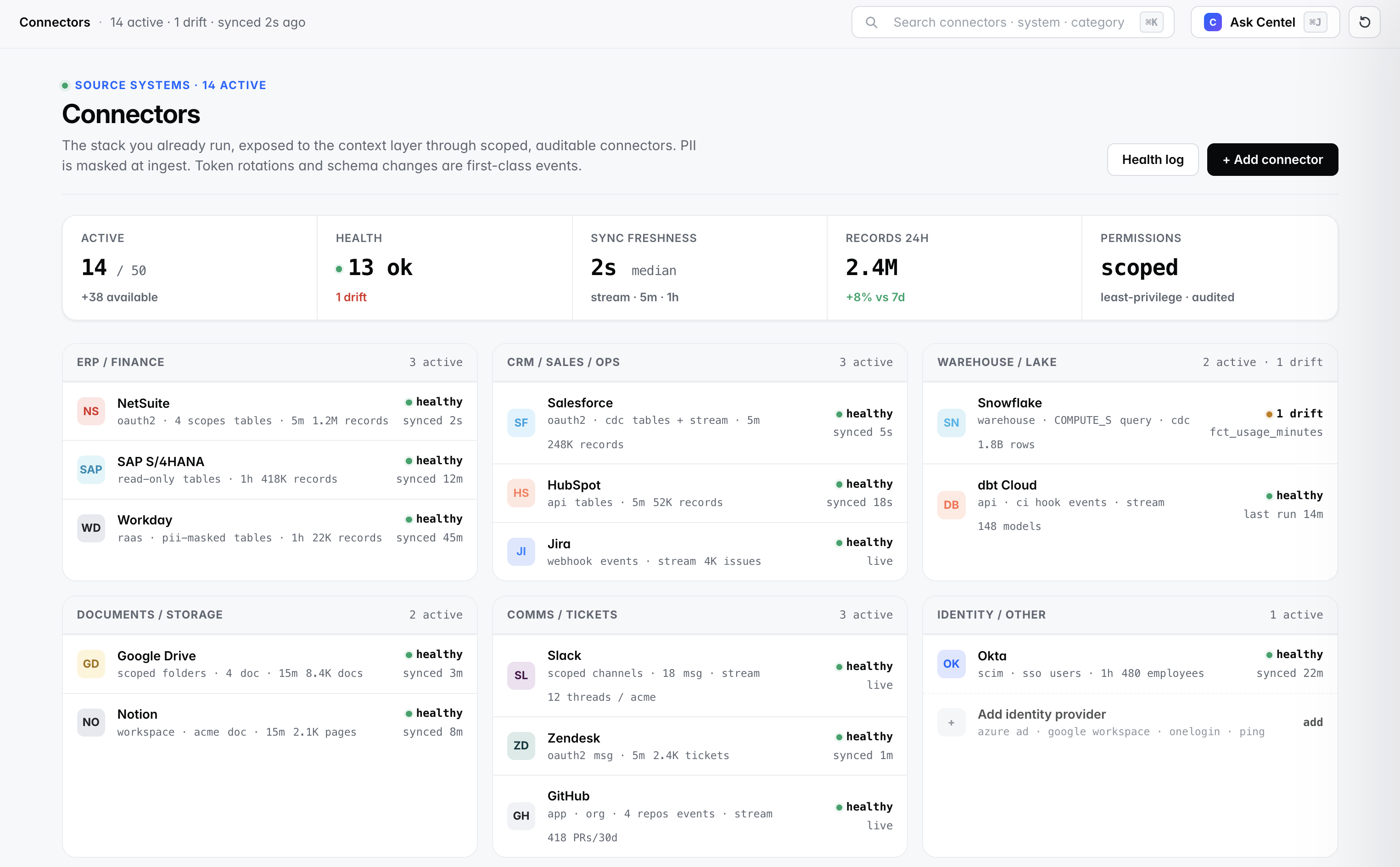
Bring in the systems work depends on through scoped connectors, metadata extractors, document parsers, or your own MCP endpoint.
Company OS for AI agents
Centel connects your systems, builds live business context, and runs governed agents for cross-system work, with every human decision captured as reusable memory.
customer.acme_corp
renewal-risk
Don't push to Odoo directly for misc invoices — always route through controller approval first.
if invoice.type == "misc" → require(controller.approve) before push("odoo")
Enterprise work is scattered across systems, documents, messages, and approval chains. A connector can expose data. It cannot explain what the data means, who owns the decision, or whether an action is allowed.
Centel adds the missing layer: resolved context, governed actions, and decision memory that compounds with use.
The dashboard still loads, but the answer is wrong.
The agent can draft, but not judge like Sarah.
The invoice is in ERP. The reason is in Slack. The usage drop is in Snowflake.
Work is not real until the right human signs off.
Agent loops turn cheap prompts into expensive operations.
Every company is different enough to break generic automation.
The operating loop
The loop is the product. Every workflow starts with trusted company context and ends by making the next workflow sharper.
Bring in the systems work depends on through scoped connectors, metadata extractors, document parsers, or your own MCP endpoint.
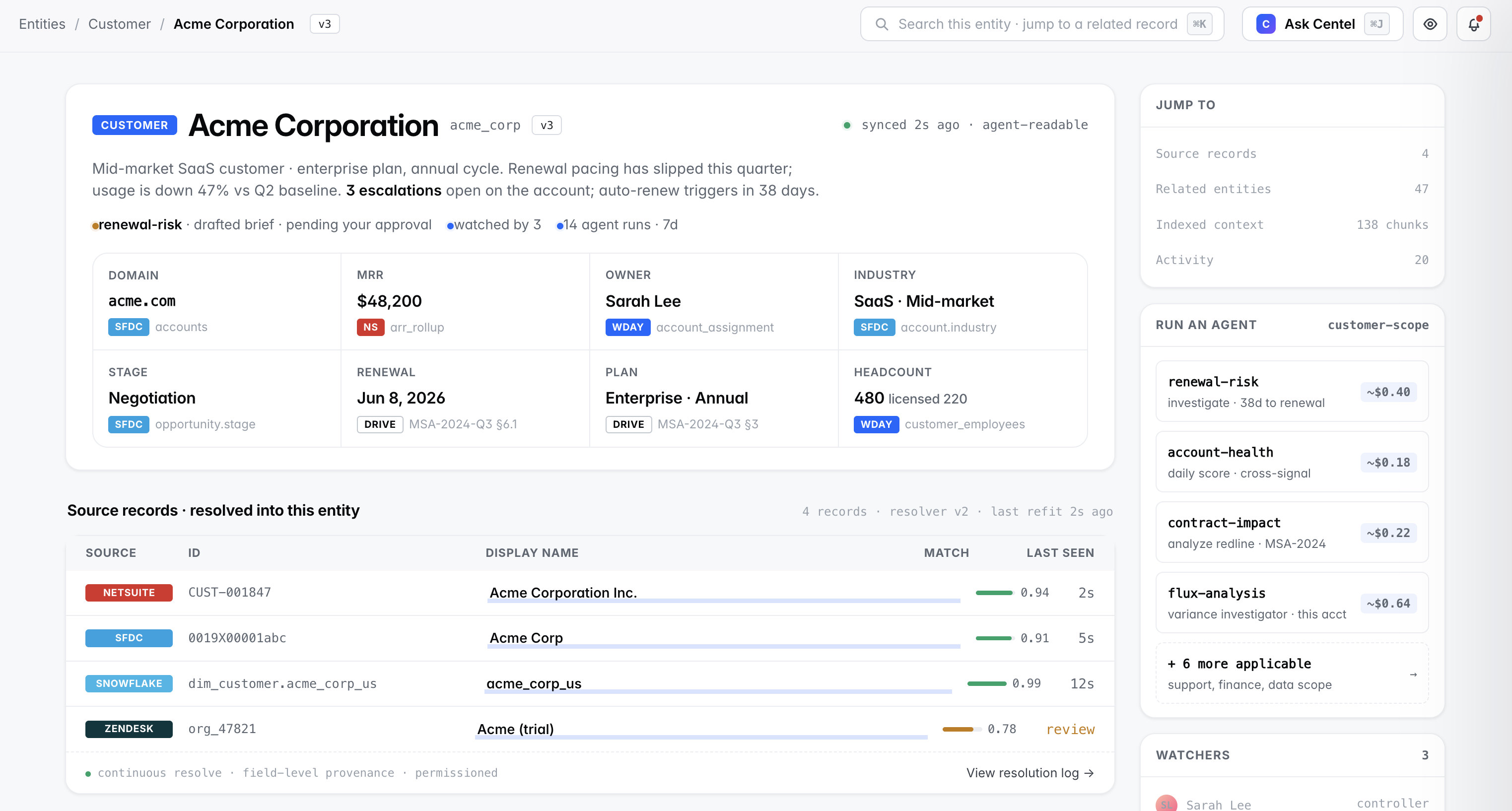
Every signal that explains your business becomes one agent-readable context layer — assembled around your existing stack without disrupting operations. Low-confidence mappings route to human review.
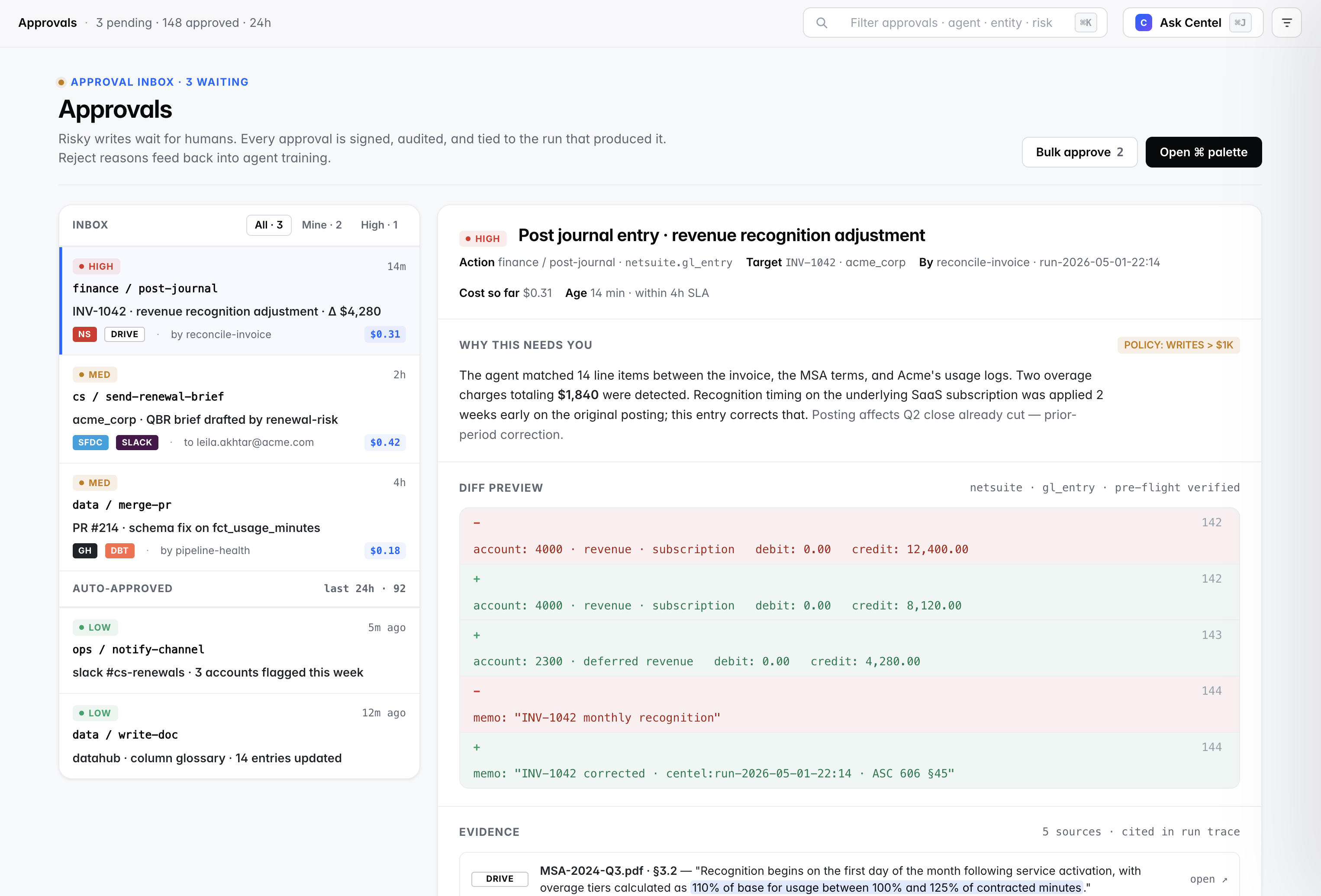
Agents investigate, draft, reconcile, route, and propose actions through policy gates, audit logs, and cost envelopes. Risky writes wait for humans.
Every approval, edit, and reviewer note becomes a reusable rule. The next workflow inherits the judgment automatically.
"Don't push to Odoo directly for misc invoices — always route through controller approval first."
if invoice.type == "misc" → require(controller.approve) before push("odoo")
What changes for the team
Approvals, anomalies, overnight runs, and spend summarized before teams open twelve dashboards.
One customer, contract, invoice, owner, and policy graph with source lineage on every field.
Every write carries evidence, diff, policy reason, reviewer, and signed audit trail.
delta · +$4,280
policy: writes over $1k require controller approval
Human edits become durable rules and skills, not one-off Slack corrections.
"Don't push to Odoo directly for misc invoices — always route through controller approval first."
policy.misc-invoice-routing
saved · auto-applied next run
Expose the same governed context and workflows through Claude, ChatGPT, Cursor, Slack, webhooks — anything that speaks MCP.
$ claude --mcp centel ask "why is Acme renewal at risk?"
→ loaded customer.acme_corp · MSA-2024-Q3 · 12 Slack threads
→ usage −47% · escalations 3 · auto-renew in 38d
→ answer cited · approval gates honored · audit trail attached
Design partner workflows become generalized packs with skills, policies, test harnesses, and cost envelopes.
Data-heavy cross-system workflows
Centel is not limited to one industry. We start with workflows where the answer depends on multiple systems, business rules, and human judgment. Then we generalize the pattern into reusable packs.
− type: int4 · nullable: false
+ type: uuid · nullable: false · backfilled
| Query pattern | Runs | Spend |
|---|---|---|
fct_orders ⨝ users full scan | 312 | $486 |
marts.revenue_daily recompute | 96 | $214 |
events.raw partition skew | 1,204 | $148 |
"Acme usage dropped 47% after their data team migration in March. Recommend exec-led save: discount renewal to 16-month at flat ARR, pair with quarterly check-ins."
email · phone → mask("hash") · tax_id → block · log("export")
                  {"user_id": 4821,
                   "email": "a3f1…8c",
                   "phone": "7e0c…44",
                   "tax_id": [blocked]}
Modular adoption
Install a workflow like schema drift, close readiness, renewal risk, or cost watcher on top of your current stack.
Best for one urgent workflow.Use Centel for context, runtime, governance, observability, skills, and decision memory across teams.
Best for design partners.Expose governed company context and workflows to Claude, Cursor, internal tools, and your own agents.
Best for technical teams.How we work
We build Centel with design partners inside real workflows. The first phase runs in shadow — agents observe, draft, and replay work while humans keep making the decisions. The output is not a one-off implementation. It is a reusable agent pack you own.
We map how the work actually happens — including the judgment calls humans make that nobody has written down.
We assemble context around your existing stack — without disrupting operations.
Agents investigate and draft against real work. Humans approve, reject, and correct. Low-confidence mappings and risky actions route to review.
The workflow becomes a packaged agent — replay tests, cost envelopes, and the configuration in your hands. Run it again. Hand it to another team.
Governed by default
Agents do not get blank-check access. Centel gives them controlled ways to retrieve, reason, and act, with policy checks before the action and audit evidence after it.
Agents only retrieve what the workflow, user, and policy allow. Customer data, embeddings, caches, and logs stay inside the tenant boundary.
Risky writes pause for the right reviewer. Approvals include the proposed action, evidence, policy reason, diff, and cost.
Run Centel as managed SaaS, single-tenant VPC, or customer-controlled infrastructure. Bring your own warehouse, vector store, and MCP endpoints where needed.
Every run records sources loaded, model route, tool calls, approvals, edits, and cost-per-outcome. Logs can export to your security and observability stack.
Enterprise readiness
No. Connectors are only how signals enter Centel.
Centel is a modular company operating system for AI agents. It can sit on top of the stack you already have, or help build the missing layers: connectors, metadata, document parsing, context graph, retrieval, agent runtime, governance, observability, and decision memory.
The goal is the same in both cases: give agents an accurate, governed understanding of how work happens in your company. That means entities, relationships, documents, permissions, policies, approvals, owners, and prior decisions are organized into agent-ready operating context.
On top of that context, Centel runs governed agent workflows. Agents can investigate, draft, reconcile, route, and propose actions. Risky work goes through human approval. Every approval, edit, or rejection becomes reusable memory for the next run.
So Centel is not just a connector product, not a consulting service, and not a background graph. It is the operating layer that lets agents understand your company, act safely, and improve through human judgment. During design-partner work, we help build the first workflows and productize them into reusable agent packs.
No. Centel is designed to avoid unnecessary data movement. For sensitive or data-heavy environments, Centel can run inside your cloud, VPC, or customer-controlled infrastructure so data stays within your boundary.
Centel connects to the systems, metadata, documents, and endpoints required for each workflow, then retrieves only the governed context agents need. We do not need to copy your entire warehouse, document estate, or operational history into a Centel-owned environment.
Centel is designed for that. Use your existing warehouse, catalog, orchestration, vector store, or MCP endpoints where they already work. Where pieces are missing, Centel can provide them. The product is modular so technical teams can adopt only the layers they need.
Centel does not assume clean data. It uses metadata extraction, lineage, document parsing, semantic mapping, retrieval, and human review to turn messy inputs into trusted operating context. Low-confidence mappings stay in review until approved, then become reusable memory.
Yes, but only through governed action gateways. Every write is checked against policy, evidence, permissions, approval rules, audit logging, and cost controls. High-risk actions wait for human approval; low-risk actions can become automated after they are proven safe.
Every design-partner workflow starts with a productization goal. We map the workflow, run agents in shadow, capture human judgment, and extract the reusable parts into an agent pack: workflow spec, skills, policy gates, replay tests, cost envelope, and customer-owned configuration.
Build with us
We are looking for data-heavy and process-heavy design partners whose work spans systems, approvals, and domain judgment.
We read every one. Expect a reply from the founders within 48 hours.